Recent News
FREE COPY of my play Red-Handed available to download HERE
'The Pebble Champion' - screenplay, WINNER, Platinum Award, LGBTQ Unbordered Film Festiival , USA, 2026
'The Pebble Champion' - screenplay, WINNER, Adapted Screenplay, Silver Remi Award, WorldFest Houston Intl. Film Festival, USA, 2025
'The Pebble Champion' - screenplay, WINNER, Best UK Screenplay, Cambridge Script Festival, UK, 2025
'The Pebble Champion' - screenplay, THE GOLD LIST British Independent Film Festival, UK, 2025
'The Pebble Champion' - screenplay, FINALIST, Toronto International Nollywood Film Festiival, Canada, 2025
'The Pebble Champion' - screenplay, FINALIST, Best Screenplay, New Renaissance Film Festival,, London, UK, 2025
'The Pebble Champion' - screenplay, FINALIST, Chicago Script Awards USA, 2025
'One of Us' - screenplay, FINALIST, Chicago Script Awards USA, 2025


Internationally recognised author, playwright, poet & screenwriter
POETRY SHOWCASE

Here is a selection of 20 poems from my two collections, Advancing Backwards (published 2011)
and Window Spit (published 2017).
Please note: Some poems contain strong language and explore mature or potentially distressing themes.
CLICK on the audio icon at the end of each poem to hear my brief notes about it.


THE DAY HITLER SHOULD HAVE DIED From behind he looks almost frightened, the little boy, although she cannot see the exhilaration in his eyes, cannot hear the trumpets of Prussian glories resounding in his ears. The other three, bigger, more menacing, make her think of the bastard asleep upstairs. Her sharpening the shop’s knives suddenly becomes overwhelmingly significant. The boy, however, advancing backwards, stops, and she sees in his defiant stance, the triumph of will over weakness, the Jacob/Angel story of her life, the struggle – he launches into what seems to be a diatribe of mad gestures; insistent and utterly convincing. She thinks he resembles a crazed minister making perfect sense. She thinks: If a boy can stand up to his tormentors, I can stand up to that cheating bastard asleep upstairs. That the boy has no need for violence makes her feel guilty. Her sharpening the shop’s knives suddenly becomes significant. The bullies will wonder for weeks to come how he did it; how his words, his conviction could so thoroughly redirect their anger, their peasant brutality. They retreated one by one to become soldiers of another war. Further up the street and out of view, a horse, fed up and thoroughly pissed off, decides enough is enough, and, still attached to the cart, suddenly takes off without his owner and gallops over the cobbles, determined not to let anything get in his way. He has heard far too many stories of stallions slaughtered on the battlefields, and wants none of it. It is Austria. It is a long time ago. Such were the thoughts of horses. It is a grey clay day. The horse is free for the first time in its life. The woman barely has time to think. She drops the knives - she won’t be able to recall when precisely she knew he was in danger. The boy stands firm, almost, she thinks, over-estimating his defiance. He thinks the thunderous clatter roaring down on him is Nature, concurring. She moves in slow motion faster than ever before; she snatches the boy just in time; she breaks her arm on, of all things, the grocer’s sandwich board, and feels God smiling on her. Later she will use the arm and the bruises as evidence of her husband’s brutality, and her brother will take care of it all one night, and her life will change. Those few seconds, clasping the child that bastard made sure she will never have, she felt she belonged - she knew she had rescued the power to love, and, her guilt assuaged, her faith restored, she knew she would never have to sharpen knives again. By the time she gets to her feet, little Adolf has run home to his mother. The moment’s significance has passed. Present, past and future collide when these things happen. His mother knows nothing of cosmic inevitability, nothing about the grim irony of fate. She is unable to share his adventures, unable to comprehend, oblivious to the noise of regiments marching in his head. She has no idea how different the world could have been had the local butcher’s wife been deaf; had a certain horse not been so hungry for change; had the cat not been sleeping where the knives fell. (Selected for publication: Poets Letter Magazine, July 2005)

DREAM BOY The so-called straight boy vomits his story over free drinks while sympathetic ears grope for his crotch. He knows the story by heart. It’s a sordid tale of suppressed love and sad disguises. Their been-there T-shirts glow in ultra violet lies and their eyes burn with nostalgia and regret - like sad mothers’ eyes. He likes, afterwards, when snogging in the darkness to grope in their pockets for the small change and change into the child they’d all like to be, the one he could never become. (Selected for publication March 1st 2005 The Persistent Mirage Magazine)

PHOTOGRAPHS: A LIFE See here: I am an asthmatic seven year old holding Time’s hand while he gently pats my head like a mother, but then stops smiling. Because this is the moment before you innocently showed me your privates. Touch it, you said - you were ten, it was hard - and I did. So here I am, seven, the moment before all of this, looking like a child lost in a supermarket. Time says, “I will mark this spot, this moment, this you, by driving a stake through your right hand,” and he did, just after you told me God would crucify us if it ever happened again. See here I am: a fourteen year old child hitching a ride with the sun in my hair, going nowhere to be on my own. Time pulls up first, gets out, pulls some shit about pretending to like the scenery (semi-desert, scrubland, and waves scratching cliffs). He mutters something about its looking better in widescreen before giving me that almost sympathetic, almost wide-screen smile, fingering the stake in his hands. Because this is the moment before you gave me a ride – or rather, your father did. The car was full and you were in the back under a blanket. I had to squeeze in next to you, and you were beautiful and horny, and your parents couldn’t see, or weren’t interested, like mine. See here: I am sixteen and in my hand I hold a letter in which I bare all to an older student with a devastating smile and a devastating girlfriend. The day before the nights of anguish, the stubborn pretence that something will happen, that you would return the love I could no longer keep secret, Time arrives without ceremony to drive a stake through my brain and to tell me I know you would never be able to give me what I want. “This,” he says, “will hurt you more than me.” See here: I am nineteen and outside a club notorious for available sex. Time appears to drive a stake through my genitals. “Because”, he says, “this is the moment before you abandon yourself to lust.” The moment before you and you and you showed me how to enjoy my youth, recklessly. See here: I’m thirty six and standing outside our bedroom door. It’s that moment before I catch you with him, the moment before you look at me as if to say it’s all your fault. Time nails my left hand to the door. He marks the moment before I smilingly expect to find you asleep, looking perfect, expecting to wake you with a kiss, expecting forever to be something belonging to us. See here: I am forty six and single and satisfied, standing beneath a tree, surveying my garden, my smug little existence away from love, sex and it’s related murkiness. I age well in night light and even have a fire to cast comforting shadows. I no longer have asthma and eat healthily. My job is my love and is more faithful. I look content when Time arrives, impassioned and punctual, with a stake for my left leg. “This is the moment,” he says, “before …” I’ll tell the story. I have my own restraining equipment. The moment before you called – I did not run to the phone. A voice from the past – you said something about a girlfriend and my devastating letter, and your need to conform. You said you meant to call/write but something always came up, which is my excuse. I said yes, let’s meet, be discreet, for coffee at a nearby café. Look: here’s a photograph of you. You had treated me to a balloon flight on my sixty-fifth. I took the picture of you looking excited and unafraid. That was the day you told me how, when we had met at that café years ago, your recurring nightmares stopped. “It’s like this,” you said, looking down and then up, “I look down at myself, stretched out, distorted, mapped with stakes to hold me as the years pull me apart, and then Time arrives with a razor blade …” You told me, later, that I had set you free. Time’s here to take our picture: You’re at my bedside, stroking my head like a mother, holding my hand with tears in your eyes. It’s a peaceful scene – the torment trapped beneath unsaid things. You turn the pages of our photo album and will, no doubt, put this one in when the light has gone. “See here,” I say before Time arrives for the last time, “I’ll be waiting for you.” I hold your hand. “Don’t let go,” you say. I say, “I let go the night you called me,” and close my eyes.

FIGS Remember when, you probably won’t – not that it’s too long ago, that funny sunny faraway day when things were just perfect and everything smelled of cheap after-shave? You probably don’t – we shared rude jokes, mine, silly; yours, needing to be explained. And when it rained, remember that? Remember the spit of summer showers - the monkey’s wedding, you said, that’s what they call it, ‘cos it happens at the same time, like our getting a hiding after stealing – was it figs? – you know I think it was, figs, there’s a funny word, like friend. Figs – and God it hurt, that hiding, that beating for telling others I saw you cry. Although I never said a word about the wet pants, I swear. And remember when we went off to university? You grew up so fast. But you still told me things, like why God doesn’t exist, and why, when things go wrong, there’s usually someone to blame, like the government. And remember when they locked you up? When you carried that rude banner protesting about something I can’t remember. And all because you were bunking off lectures. I can’t forget that it was me you called instead of your folks. Remember, nah – I know there’s no point, I was your best man at both your weddings, and I was really happy for you, twice. And remember when I told you about my boyfriend James, remember that day? When it rained while the sun shone, when you nodded while I went on and on, like you probably do now about your grandchildren. Who can remember? There’s nowt as queer as folk. Yet, I cannot believe that you have forgotten the very last day that we ever spoke. (Selected for publication: Coffee House Poetry Magazine Issue 9: 2005)

OVERLOOKED A good kid: never any trouble. The sort of kid other parents wished they’d had: calm, content, caring, quiet – his name might sound almost familiar. After his mum shouted at the eldest for putting his hand up the neighbour’s skirt, and doors banged, and glass broke, he made her tea, held her hand while she disintegrated on the sofa. The rows then became more frequent: his brother had found drugs; his sister, an older man. He, by getting on with his homework, found he could avoid being shouted at, could avoid having to compete for attention. When her husband forgot to invite her to the new year’s eve party, he swept up the glass she said she’d dropped, and, at midnight, they shared champagne from a coffee cup while she sat at the window, staring at the storm. But that is not what this is about. He fell in love – it was an overwhelming thing – at fifteen while changing for PE; he had tingles he knew he could keep only as secrets. Cursed with the insight that creates torment in poets, battered by more than mere adolescent longing, he wandered home to find the front door window broken, his mother in tears. Just before Christmas he decided to write it all down, decided to let the words tumble without restraint, like the products of a storm. He knew that it was the most significant letter he’d ever write; understood, when it was done, that loving alone is not enough; that having it read would destroy him. When the noises became nasty, he’d read it again, trying to curl up within the sentences, as if that alone would save him. Yet, each time the shouting rose, he’d hear their voices reading his words, and something, sometimes the very thing, would sound wrong, ring false, and He’d scratch it out, as if that would make them go away. The letter gradually disintegrated, clichés crumbled and everything that could be mocked, removed. What remained oddly resembled a poem, something only the receiver could appreciate. He posted it. On New Year’s Eve he drank champagne with his mum after receiving a rude call from a boy who made his flesh tingle. But that is not what this is about. (Selected for publication: The Poet’s Letter Anthology of New Voices, June 2005)

THE VISITOR We have kept it alive, this half-dead thing, feeding on promises and doubts and needs, needing somehow to believe, then to sing about its wonderfulness, while it bleeds for a heart without restraint, a soul unfettered by vague desire, past regret – kept it alive with titbits which we stole from other dreams, unable to forget. It was never ours – like a wandering child adopted into the home of barren hearts. Nor could it stay near a couple so wild with needs and bruised by too many false starts. We’ll be lonelier still, and sad to know, that love visited once, but had to go. (Selected for publication: Inclement Poetry Magazine Winter 05)

WHAT YOU MAKE OF HIM He sees things that aren’t there and stares at them for a long time. He compares himself to others mirrored by what he thinks they say about him. Although he takes the necessary precautions, he knows germs have grudges – like humans. He knows there is menace behind being polite. He feels bound; they have hidden pleasantries in barbed wire. He believes his only release from the hypocrisy of conforming is the gossip of so-called friends. (Selected for publication: The Poets Letter Online Poetry Magazine, June 2005)

STRANGER BUS STOP My horoscope predicted my meeting a stranger, and here we sit, waiting for a bus which takes forever to arrive. There’s no shelter at this stop, he grumbles, and the bus is late, and the chill factor, cruel. Tomorrow I’ll wait, he says, warm and at ease with the world, only to see my bus – he points, break down at the top of this road. Something makes me think we have met before. He continues: the day after I’ll finally catch the bus, only to curse the wind when the driver collapses at the wheel and we are almost destroyed. He shakes his head: the following day will find me running for a bus I’ll never catch, and so, probably, before the week is through, I’ll end up walking, walking, walking - just in case. And you know, he admits, I know it’ll be inconvenient, to say the least, but at least I’ll avoid life’s little irritations. Stop trying, he says, giving me his ticket – to become something you already are. He gets up, walks away. (Selected for publication, Issue 3, Orphan Leaf Review Magazine 2005)

NINE-TENTHS OF THE LAW That it should come to this: he leaves you because you try to kill him in your sleep. You say you don’t, you say you aren’t aware, but it’s true – they’ve done all the tests. It has a long name, your condition, and while there is absolutely nothing wrong with your relationship, and while you two are so totally rightly justifiably made for each other, and while there isn’t exactly a known cure, if it wasn’t for the killing thing, my guess is you’d make the cover of Gay Couples Monthly, or Cemented. It’s just this killing business which is causing concern. You see, or rather, you don’t – while you are sleeping, you grip his neck and squeeze hard as if it’s breaking you want to do. Every night – it’s been like that since the night you met. All it takes to get you off him, though, is a sharp jab to the ribs, and you roll over, growling. Inevitably, though, he always wakes clamped in the crook of your elbow, and you, with a bruise somewhere. He hasn’t complained much, well – you know, and would have said something sooner but, like you, felt you two belonged, especially because, during the day, you make him feel so wanted. (Crying innocence is all and well and will, no doubt, garner some sympathy – everyone can see how much you love him.) Watch him walk away with marks around his neck, looking back because even he’s not sure, and when he’s gone, and his side of the bed stretches before you like a prison sentence, know this: it’s not the daily loving that drove him away – it was the nightly murder that he could not endure. (Selected for publication: The Truth Magazine, 2005)

THE TERRIBLE TALE OF A MAN TOO BRUISED BY LOVE There is this man who builds his house on the edge of a cliff so he can watch disasters occur below him. The cliff fringes a wasteland (no helicopter-Hollywood shots of an idyllic retreat – no) and it takes him weeks to walk to the nearest shop. “Damn inconvenient,” we tell him so, “139 miles to the nearest advertisement. No electricity for the house. Nothing. Just wasteland and sea – the one’s just wetter than the other,” we tell him, adding, “the butt-end of nowhere.” But, he doesn’t listen. He builds his house on the edge of a cliff, where he lights candles to warn passing ships not to get too close, and they always do, and the rocks eat them up. I’LL NEVER ALLOW ANYONE NEAR ME AGAIN! he howls into the sound-scoffing wind, and then goes back to lighting useless candles which the wind blows out because he has no windows just holes in the wall. Shack is a good word. Can’t really call it a house. Bollockshrinkingly cold, which is why we used to bring him blankets (we’d drop them outside the bullet-proof electrified enclosure surrounding three sides of his shack surrounded by hidden landmines) and we’d find them – the blankets – later, washed up on the shore. The wind’s fierce up there, ‘especially this time of year. Comes a time, he stops his bi-annual trip for supplies (lots of toilet paper) and we hear nothing for months – ‘cept when one of the old-timers electrocuted himself putting canned food too close to the fence. We all want to help him, you see. Listen to me talking about him as if he’s still alive, no – he’s long gone now. Just a pile of rocks – we still can’t get too close – looks that way, like a makeshift grave without a headstone, without a cross. Pity. He had a nice arse. (Selected for publication: The Poet’s Letter Anthology of New Voices, June 2005)

WINDOW SPIT I saw your Facebook post. My God, it off-ended me! There'll be no 'likes' from this finger, and I'll report your ass, you'll see. I'll take two hours from my day, to vent my displeasure supreme, and let everyone I know know just how offended I've been. How dare you have views that are so very different from mine? OMG, the way you share and update them all the time! It's like you have nothing better to do than to spend each minute each day offending decent folk like me with everything you say! I have every right to be so terribly put out, every right to be so very bitter. The world will soon know how I feel when I tweet about it on Twitter!

CONCENTRATION BAN Stop sharing your poetry with us. We don't want your words. We want scandal, celebs, memes and cute pictures of kids or birds or anything else that is easy to skim within a second or two. Don't make us waste precious time reading stanza after stanza of you going on and on about this or that. We only have time for - oh, look - a cat!

HOT OFF THE PRESS A celeb was seen in a too-high skirt – it made the front page of the news. Another was found too-high in the dirt – and dead, some said, paying his dues. A minister sent rude texts to a girl – the headlines exploded with glee. Sordid details that’ll make your toes curl – it involves his neighbour, you see. Also, pictures of giraffes giving birth – these things are what matter today; with ten easy steps to decrease your girth – and five to make your lover stay. There are football results to shout about – We’ll Twitter and update you soon. OMG! This morning two yolks came out when I cracked an egg with a spoon. Across the ocean in Afghanistan two children were shot in the face. It’s a war waged by democratic lands using technology and space. Collateral damage, an unwritten report: innocent lives unworthy of even ink, gone; smothered by noisy indifference – news and sport – silenced savagely by those droning on and on.

WHAT JOB THE POET? How can I possibly know what you're going through? I've never felt the utter terror common for you, never felt the sheer hopelessness that can accrue when the world's indifference cuts sharply into view: the angry hurl of mortar, the cruel collapse of clay, the screams, the sirens, the anguish of dismay; brick-bruised, suffocating dust, the flames that burn beneath a broken crust; splattered blood drying on stone – no, I can never claim to have known this reality. Neither have I felt the sun-scorched hell of sun-dried veins torn from the skull, and sand-papered tongue in bloated cheek too dry to cry, too parched to speak – no, these sensations are foreign to me. Nor can I know what a dying man will see as he is hurled face-first into mortality, as he drops and swirls in the frozen abyss – no, not yet, not yet, do I know of this. So what job, then, the poet, and the painter too, the writer, sculptor and musician who find it impossible to sit idly by when the wells of empathy have run dry?

I NEED TO KNOW So you aren’t a real poet? No. I just take words and kick them at imaginary goalposts spray-painted against the rough brickwork of my memory, like a poor kid with dirty feet and a squalid imagination penalty kicking at the noise of jumbled graffiti mindlessly messing about in a concrete makeshift playground. So your words aren’t poetry? No, my words are vomit that I smear with newspaper to make patterns to delight the squeamish, and as the rains of some other experience shove them towards the drains, the implications of change become something to momentarily consider. So this isn’t a poem? No, this is exactly as much of a poem as the dirty shark-shaped cloud is a real fish that you catch with a broken umbrella in the shade of a boring summer’s haze. I am glad I could console you with the quiet certainty of my dirty lies. So you aren’t real? Yes.

OCD Is it a compulsive need to be heard, this obsessive word-piling, this absurd semantic filing, this eccentric tic to make ideas stick in just the right way? Or maybe it's something that needs to be said, that ought to be bled like carcasses of thought hunter-caught and carved for display? Or maybe the words are just magnets of gladness attracted to sadness, had-ness? fad-ness? madness? Repelled by prose, only the poet knows what they are forced to say.

IMPOTENT Right now, I could be shopping for that lady whose flat at the end of the hall smells of unwanted meals, unwanted smells that stain the walls like regret. Right now, I could be reading hopeless stories about distracting adventures to kids who won't be here next week, or tomorrow; or telling jokes, or performing the kind of magic that delights but does not fool anybody. Right now, I could be shovelling smelly shit for the shelter downtown, while listening to the distracting banter of volunteers about the hopelessly inadequate funding for unwanted pets – and the unnecessary need to put so many of them down. Or maybe I could just be walking, simply smiling for strangers who may simply have had a rather bad day. Instead, right now, I am staring at the walls, still waiting for the phone to ring because you said you would call.

SHARK I thought the shadow was that of my canoe – the inevitable consequence of rowing in the sunshine, of waving at those on the sand, of looking ahead, of keeping my chin up. The fins should have given it away, but to me it was just the silhouette of a simile lurking beneath the surface, something occasionally glimpsed at, the necessary exhaust of effort. The stalking should have given it away, the constant circling, but I saw it only as the inevitable contrast of a sunburnt smile. The yin, the yang, the need to shit after a hearty feast. I am not sure when I realised the dark shape was hungry for more than the chase, when I knew I'd be devoured as soon as the smile drained from my face, when I was sure the race to out-row the shadow would end with my dropping the oar. The intense effort to keep rowing, to keep waving, to keep keeping my chin up, to keep being grateful I could still move forward feeling the sun when others were floundering (or worse had sunk to become fuel for some deeper force) is exhausting. "What's your problem?" they spit. "You need to sort out your shit." There is blood in the water.

CRISIS You knocked on my door one day to ask if you could stay. I have only one spare room I said, and you said that's okay. And in you came, I felt so glad to have helped a mate. I changed the sheet, and cooked some meat, and offered you a plate. And then, another knock, this time, your wife, and your children, two. I hope you don't mind, you said, but what are we to do? We need a bed, and to be fed, and somewhere warm to dream. We've lost our home, we've lost our town, been bombed to smithereens. Of course, I said. (I checked my pot, unsure how to make it more.) Come in, I said, it's all I've got, and then more knocks upon the door. In came her father and her mother and their cousins too, plus a dog, a camel, a cat – and then I saw the queue. Sorry you said, but what are we to do? Oh, one more thing, the meal you bring it's just not made the way we pray, if you don't mind, if you'd be so kind, please throw the lot away. And that cross hung in that den, it offends our view. We'll also need the other room, the one reserved for you. I know it's harsh, I know it's tough, but it's not how it seems. We've lost our home, we've lost our town, been bombed to smithereens.

THE OTHER SIDE We cannot go home anymore, there is no playground safe from hate; no underground bunker in which we're secure, nor sanctuary from this bomb-battering state. Our daughters are wrenched from our hearts, their horrors too dark to contemplate; all running away just begins false starts, all staying, slaying at a relentless rate. We give what we can to get a boat, and raft our hopes upon the sea, relying on profiteers to keep us afloat, hoping our prophet sees our misery. And if we get to the other side, to sidestep our dead upon your shore, can we expect arms open wide, from you who felt such horrors before? Or will you slam the door in our face, and spit and gossip and sneer about our clothes, our needs, our race, the extremes that brought us here? What if I were your long-lost son, the daughter you had not seen in years? Would you be so quick to get a gun, or herd us away with loaded jeers?
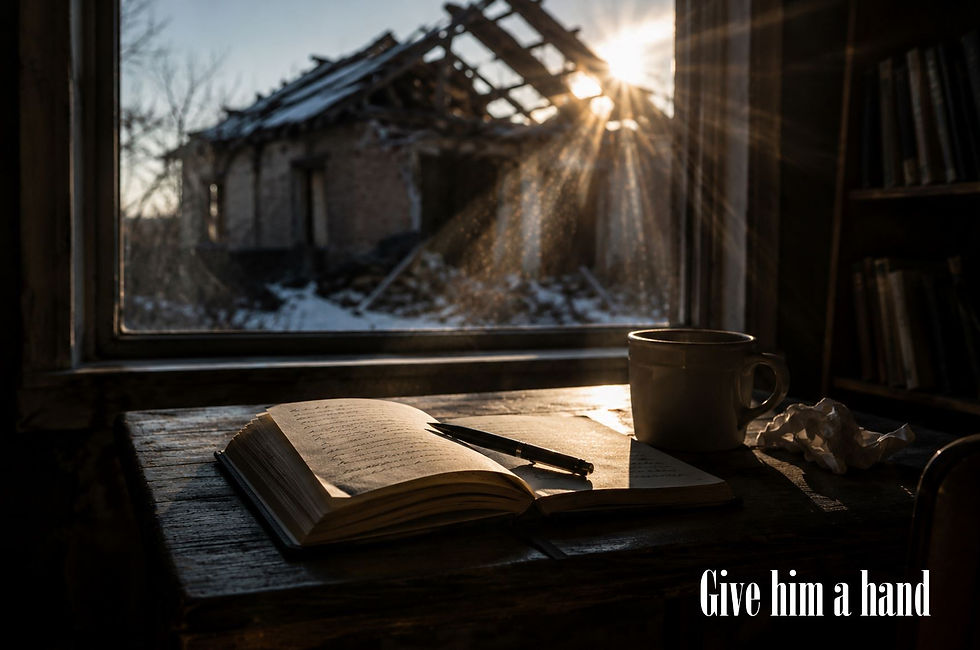
PUT DOWN Put down your words, mister poet man, this is not the time to rhyme; not the time to comment about the hardship of a neighbour’s broken ceiling (although there is a certain insistent splendour about the winter sun’s peacock-like splinter through his fragmented roof) – stop. Your attention is needed elsewhere now. Lay down your similes and schemes. Your insight won’t warm his shivering child, won’t shield him from the chill, won’t shield you from the fallout of beautifully phrased sympathy. Your hands are needed elsewhere now.
If you have enjoyed this work, please consider purchasing my books on AMAZON.
Also, if you would like to view internationally-acclaimed video poems from this collection, CLICK HERE
or visit/ subscribe to my YouTube page: https://www.youtube.com/@MrAlanDavidPritchard
Thank you!